
Is an Electric Car Repair Shop a Smart Investment in the US Compared to Gas Car Repair Shops
Electric vehicles are no longer a niche product in the US, but they are not yet the dominant car on the road either. That makes the repair business tricky. The opportunity is real, yet the timing, location, training costs, and service mix matter more than the hype.
For investors, the key question is not whether EVs are growing. They are. The better question is whether an electric car repair shop can generate steady shop volume soon enough to beat the proven, cash-flow-heavy model of a gas car repair shop.
The short answer: an EV repair shop can be a smart investment in the US, but usually not as a pure EV-only repair shop in most markets today. A hybrid model that services gas cars while building EV capability is often the stronger bet.
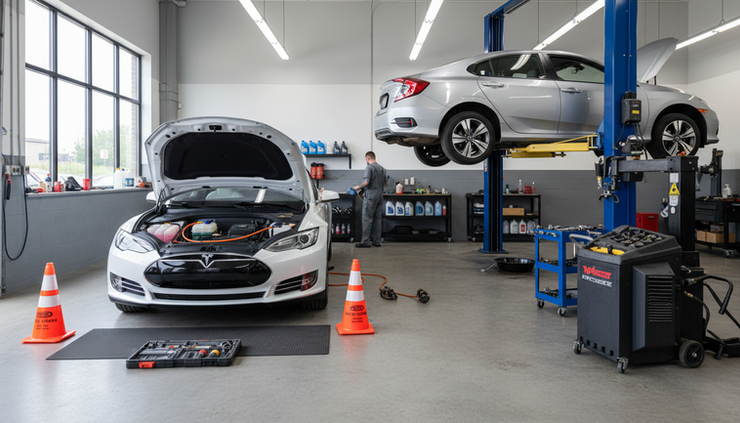
The US vehicle market is moving toward EVs, but slowly
EV adoption in the US is growing, but the repair market follows vehicles on the road, not just new vehicle sales.
Industry trackers have reported that battery electric vehicles made up roughly 7% to 8% of US new vehicle sales in recent years, with more than a million EVs sold annually. That is meaningful growth. But the total US vehicle fleet is huge, with well over 280 million registered vehicles. Most of those are still gasoline or diesel vehicles.
That creates a lag.
A repair shop makes money when cars age, break, wear tires, need inspections, get into accidents, and fall out of warranty. Many EVs on the road are still relatively new, and a large share of serious repairs still go through dealer networks, especially when high-voltage battery systems are involved.
So the near-term market looks like this:
Market factor | EV repair shop | Gas car repair shop |
Current vehicle base in the US | Small but growing | Very large and mature |
New vehicle sales trend | Growing share | Still majority of sales |
Typical customer awareness | Still developing | Well established |
Warranty influence | Strong on newer EVs | Less dominant on older vehicles |
Independent shop competition | Lower in many areas | High in most areas |
Technician availability | Limited | Easier to find |
Equipment and safety needs | Higher upfront cost | Familiar and widely available |
This does not mean EV repair is a bad investment. It means the best entry point is often selective. Shops that add EV service before competitors do can build a reputation early. Shops that go all-in before local demand exists may struggle to fill bays.
EVs need less routine maintenance, which cuts both ways
One of the biggest selling points of electric vehicles is lower maintenance. EVs do not need oil changes, spark plugs, timing belts, fuel pumps, exhaust systems, or many traditional engine repairs.
That is great for EV owners. It is not automatically great for repair shop revenue.
A traditional gas car repair shop often depends on repeat services such as:
Oil changes
Brake jobs
Fluid services
Engine diagnostics
Emissions-related repairs
Cooling system work
Transmission service
Exhaust repairs
EVs remove or reduce several of those revenue streams. Regenerative braking can also reduce brake wear, though brakes still need service due to corrosion, caliper issues, pads, rotors, and brake fluid.
Still, EVs are not maintenance-free. They need:
Tires
Alignments
Suspension work
Cabin filters
HVAC service
12-volt battery replacement
Brake inspections and service
Cooling system service for battery and power electronics
Software-related diagnostics
Charging system checks
High-voltage safety inspections
The tire category is especially important. EVs are often heavier than comparable gas cars because of the battery pack. They also deliver instant torque. Many owners notice faster tire wear, especially on heavier crossovers and performance EVs.
That makes tires, alignments, suspension inspections, and brake maintenance important profit centers for EV-capable shops.
EVs reduce some traditional maintenance income, but they do not eliminate repair demand. They shift the money toward diagnostics, tires, suspension, electronics, thermal systems, and collision-related work.
Gas car repair shops still have the stronger short-term demand
A gas car repair shop has one major advantage: the customer base is everywhere.
The average vehicle age in the US is more than 12 years, according to commonly cited industry data from recent years. Older vehicles need more repairs, and most older vehicles are gasoline-powered. That gives traditional shops a steady stream of work from aging engines, worn transmissions, leaking gaskets, faulty sensors, cooling systems, and emissions components.
Gas car repair shops also benefit from customer habits. Drivers know where to go for an oil change, check engine light, brake noise, or engine misfire. Independent shops, quick-lube centers, tire stores, and transmission shops all fit into a well-understood repair market.
That mature market has downsides too.
Competition is intense. Many cities and suburbs already have several independent repair shops, dealership service centers, tire stores, national chains, and mobile mechanics. Labor rates can be strong, but customer acquisition can be expensive. Price shopping is common, especially for routine services.
EV repair has the opposite profile. Demand is smaller today, but competition is thinner in many areas. A shop that becomes known for EV diagnostics, tires, brakes, and safe high-voltage practices may gain a strong local position before the market gets crowded.

Startup costs are different for EV repair shops
An EV repair shop may need less equipment for engine and exhaust work, but it needs specialized tools, safety equipment, and training.
Common EV-related investments include:
High-voltage safety training
Insulated tools
Personal protective equipment
Battery lift tables or support equipment
EV-capable scan tools
Charging equipment
Updated service information subscriptions
Isolation testers and electrical diagnostic tools
Shop procedures for high-voltage disablement
Fire safety planning and storage protocols
A gas car repair shop usually needs a broader base of mechanical tools, lifts, compressors, fluid equipment, emissions tools, and diagnostic platforms. Many of these costs are familiar and easier to price. Used equipment is also widely available.
The challenge with EV equipment is not just cost. It is confidence. A shop owner must know which vehicles the shop plans to service and what level of service it will offer.
There are three realistic models.
Service model | What it handles | Investment level | Best fit |
Light EV service | Tires, brakes, filters, alignments, 12-volt batteries | Lower | Existing tire or general repair shop |
EV diagnostic shop | Drivability issues, charging faults, electrical diagnostics, thermal systems | Medium to high | Skilled independent repair operation |
High-voltage battery repair | Battery module work, pack testing, deep electrical repair | High | Specialist shop in a high-EV market |
The third model gets attention, but it is not the easiest place to start. Battery repair can require serious training, space, liability planning, and vehicle-specific procedures. It may also face parts and warranty limitations.
For many investors, the safer path is to start with high-demand EV services that overlap with traditional repair: tires, brakes, suspension, alignments, cooling systems, HVAC, and diagnostics.
The labor problem is real
The US auto repair industry already faces a technician shortage. EVs make that problem sharper because high-voltage systems require training, discipline, and comfort with electrical diagnosis.
A good EV technician needs skills that go beyond parts replacement. They must understand:
Electrical theory
High-voltage safety
Scan tool data
Battery cooling systems
Charging systems
Software updates and service information
Hybrid systems, since many shops will see hybrids before full EVs
Gas car repair shops also struggle to hire, but the labor pool is larger. More technicians have experience with internal combustion engines than with battery electric systems.
This affects investment returns. A shop can buy tools faster than it can build a skilled team. Training should be part of the business plan, not an afterthought.
A strong approach is to hire or train technicians in stages. Start with hybrid and light EV service. Move into deeper diagnostics after the team has field experience and written safety procedures. Add high-voltage battery work only when demand supports it.
Location may decide whether the investment works
An EV-focused repair shop in Los Angeles, San Francisco, Seattle, Denver, Austin, or parts of the Northeast has a stronger demand base than one in a rural area with low EV adoption. EV ownership tends to be higher in places with stronger charging access, higher incomes, state incentives, and more early adopters.
That creates a regional divide.
In high-adoption metro areas, an EV-capable shop can stand out. Customers may already own Teslas, Chevrolet Bolts, Ford Mustang Mach-Es, Hyundai Ioniq models, Kia EV6s, Nissan Leafs, Rivian trucks, and plug-in hybrids. Many of these owners will look for dealership alternatives as warranties expire.
In lower-adoption markets, a pure EV shop may sit idle. A gas car repair shop with EV capability can still win because it serves today’s fleet while preparing for tomorrow’s fleet.

Revenue opportunities are not the same
The strongest EV repair opportunities are not always the ones people expect.
Many investors imagine battery replacement as the big-ticket service. It can be, but it is also complex. Parts access, warranty coverage, safety rules, and brand-specific systems can limit independent repair opportunities.
More practical revenue may come from repeat, lower-risk services.
Tires and alignments
EVs can be hard on tires due to weight and torque. This creates steady service opportunities, especially for shops that educate customers on rotation intervals, alignment checks, and EV-rated tires.
Brakes and suspension
Regenerative braking reduces pad wear, but suspension parts still wear. Heavier vehicles can put stress on control arms, bushings, shocks, struts, and wheel bearings.
HVAC and thermal management
EVs rely heavily on temperature control. Battery packs, power electronics, and cabins all need thermal management. This can create skilled diagnostic work.
Charging issues
Customers may face problems with onboard chargers, charge ports, cables, home charging setups, or software-related charging behavior. A shop that can separate vehicle problems from charger problems has value.
Used EV inspections
As more used EVs enter the market, buyers will want battery health checks, tire and brake inspections, diagnostic scans, and charging evaluations. This may become a strong service category.
Gas car repair shops, by comparison, have broader revenue sources. Engine, transmission, exhaust, emissions, fuel, ignition, cooling, and lubrication work all support shop volume. That diversity protects revenue today.
The trade-off is future direction. Gas-only shops may face long-term pressure as EVs and hybrids gain share. EV-capable shops may grow into a rising category, but they must survive the slow transition.
A side-by-side investment comparison
For a US investor, the choice is not simply EV versus gas. It is cash flow now versus positioning for future demand.
Investment factor | EV repair shop | Gas car repair shop |
Near-term customer volume | Lower in many markets | Higher almost everywhere |
Long-term growth potential | Stronger | Slower over time |
Routine maintenance revenue | Lower | Higher |
Diagnostic complexity | High | Medium to high |
Tooling uncertainty | Higher | Lower |
Technician training burden | Higher | Moderate |
Competition | Lower in many regions | High |
Customer education needed | Higher | Lower |
Best business model today | Hybrid or EV specialist in high-adoption markets | General repair with gradual EV training |
A pure gas car repair shop is still the safer short-term bet in many parts of the US. It serves the vehicles people already own, especially older cars that need frequent repairs.
An EV-only shop is a higher-risk, higher-positioning investment. It can work in the right metro area, especially with strong technician talent and a clear service focus. But in many markets, the better investment is a general repair shop that becomes EV-capable before local competitors do.
The smartest model may be a blended repair shop
The best answer for many investors is not to choose one side. A blended shop can service gas vehicles, hybrids, plug-in hybrids, and battery electric vehicles.
This model has several advantages:
Gas vehicles keep bays full today.
Hybrid service builds electrical diagnostic skills.
EV services create a future-ready reputation.
Tire, brake, suspension, and alignment work apply across all vehicle types.
Training costs can be phased in over time.
Hybrids deserve special attention. Toyota, Honda, Ford, Hyundai, Kia, and other brands have sold large numbers of hybrids in the US. Hybrid repair can be a bridge between gas and EV work because it combines internal combustion systems with high-voltage components.
A shop that understands hybrids may be better prepared for full EVs than a shop that jumps straight from oil changes to battery diagnostics.

Key risks before investing
The EV repair opportunity is real, but investors should avoid a few common mistakes.
Overestimating local EV demand
National sales numbers do not guarantee local repair volume. Check EV registrations, charging density, local income patterns, and dealer wait times in the target area.
Building around battery replacement too early
Battery work may sound profitable, but it is not always accessible or frequent. Start with services that customers need now.
Ignoring insurance and safety procedures
High-voltage work requires strong safety controls. Insurance coverage, technician certification, written procedures, and proper equipment matter.
Underpricing diagnostics
EV diagnostics can take time. Shops that charge like a basic oil-change center may lose money on electrical diagnosis.
Failing to educate customers
Many EV owners do not know when they need service. Clear inspection packages, battery health reports, tire wear checks, and charging diagnostics can help create trust.
So is it worth investing in an EV repair shop recently?
Yes, but the strongest answer is conditional.
An electric car repair shop is worth considering if it is located in a high-EV adoption market, has access to trained technicians, focuses on practical services, and has enough capital to wait for demand to mature. It becomes much riskier as an EV-only shop in areas where most vehicles are still gas-powered and drivers rely heavily on dealerships for EV service.
Compared with gas car repair shops, EV shops offer better long-term positioning and less competition, but usually have weaker near-term volume and higher training demands. Gas repair shops still have the stronger customer base today, but they face a future where part of their traditional maintenance revenue slowly shrinks.
The most balanced investment in the US is a modern independent repair shop that keeps serving gas cars while adding hybrid and EV capability. That model follows the actual market instead of betting too early on a full transition.
This article is for general informational purposes only and is not financial advice. Before investing, build a local market study, estimate equipment and training costs, review insurance requirements, and compare projected bay utilization for gas, hybrid, and EV services.
The repair market is changing, but it is not changing all at once. The investors who win will be the ones who serve the cars on the road today while preparing for the cars that are coming next.


Comments